Round rules
How to Play Falling Pickaxe: Rules and Step-by-Step Guide
To start playing Falling Pickaxe you only need to pick a bet and press spin. Below: what every button on the screen does, how a round goes from the reel to the payout, and the mistakes people make in their first minutes.

Contents
- Falling Pickaxe rules in a nutshell
- Falling Pickaxe interface buttons
- How to play Falling Pickaxe step by step
- The reel: cross or pickaxe
- What to read on screen during the drop
- When the round ends and the win is paid
- Turbo and autoplay
- Falling Pickaxe strategy: what works and what doesn’t
- Common beginner mistakes
- Falling Pickaxe rules: questions
Falling Pickaxe rules in a nutshell
Every round of Falling Pickaxe is one pickaxe and one mine. You bet, the reel hands out a tool, the tool falls and breaks blocks. Ore pays a share of the bet, plain rock pays nothing. When the pickaxe runs out of durability, the round closes and the win goes to your balance.
The overview, pros and cons are in the Falling Pickaxe review; this page is about what to press and what to watch. You can’t influence the drop. You don’t pick a direction, open tiles or press “cash out”. Learning to play Falling Pickaxe means learning to read the screen: what you got, how much durability is left and what paid.
Falling Pickaxe interface buttons
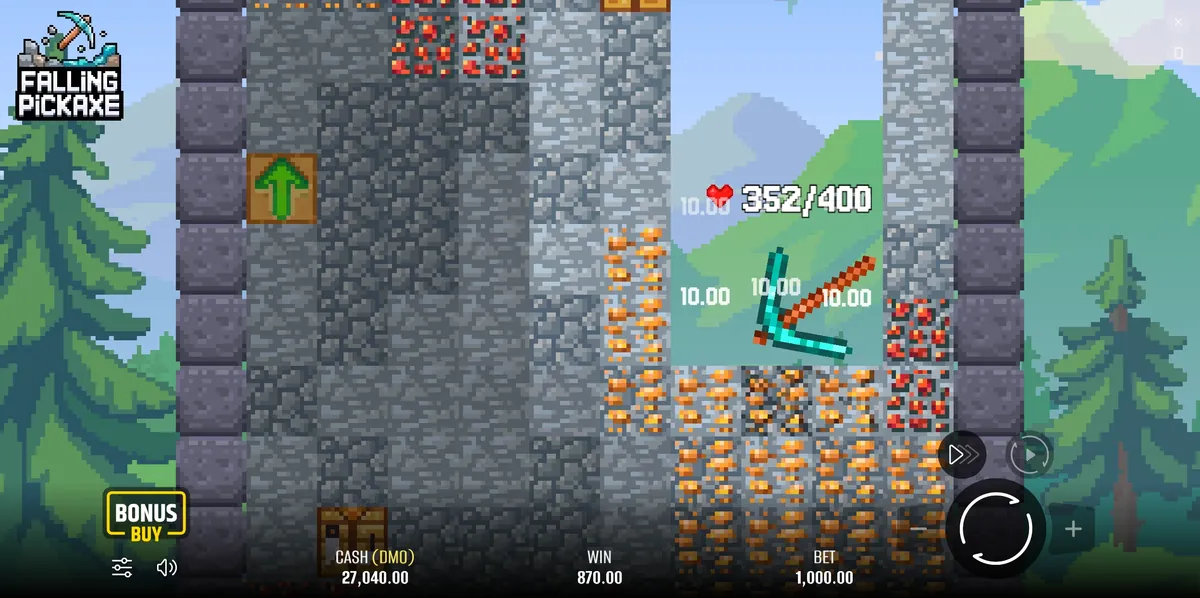
The game screen is the same on desktop and mobile — how to launch it on a phone is covered on the Falling Pickaxe download page. Here is what sits where.
| Element | Where | What it does |
|---|---|---|
| Round button with arrows | Bottom right | Starts a round (spin) |
| “−” and “+” | Either side of spin | Lower and raise the bet |
| Double-arrow button | Above spin | Turbo: speeds up the drop animation |
| Circular arrow button | Above spin | Autoplay: several rounds in a row |
| BONUS BUY | Bottom left | Buys a bonus round |
| Sliders and speaker | Bottom left | Settings and sound |
| CASH / WIN / BET | Bottom bar | Balance, round win and current bet |
| Heart with a number | Next to the pickaxe | Remaining durability (HP) out of the starting amount |
In demo mode the balance reads CASH (DMO); on a real-money account it shows your currency.
How to play Falling Pickaxe step by step
- Choose your bet. Set the amount with “−” and “+”. Minimum and maximum bets depend on the casino and are shown in the game.
- Press spin. The reel turns and stops on one of five outcomes.
- Check the reel. A cross ends the round. A pickaxe starts the drop.
- Watch the drop. The pickaxe falls and hits blocks. Every hit is −1 HP. A sum appears above each ore block it breaks.
- Wait for zero. When the HP counter hits zero, everything collected lands in the WIN field as one sum.
- Decide whether to continue. The next spin is a new reel, a new pickaxe and a new mine. The previous round has no effect on it.
The reel: cross or pickaxe
The reel has five outcomes: a cross, or a wooden, stone, iron or diamond pickaxe. A cross is a lost spin with no drop. The pickaxe sets this round’s durability: 100, 150, 200 or 400 HP.
The rules give one guarantee: after seven crosses in a row, the eighth spin always brings a pickaxe. It guarantees a tool, not a win — you may still get a wooden pickaxe over plain rock.
Why a run of crosses is no reason to raise the bet
Every spin is independent. A sixth cross in a row does not make the seventh spin “due”, and the eighth-spin guarantee only promises a pickaxe. Raising the bet after losses increases your spend, not your chances.
What to read on screen during the drop
While the pickaxe falls, keep an eye on three things:
- Pickaxe type — by colour: wood, stone, iron or diamond.
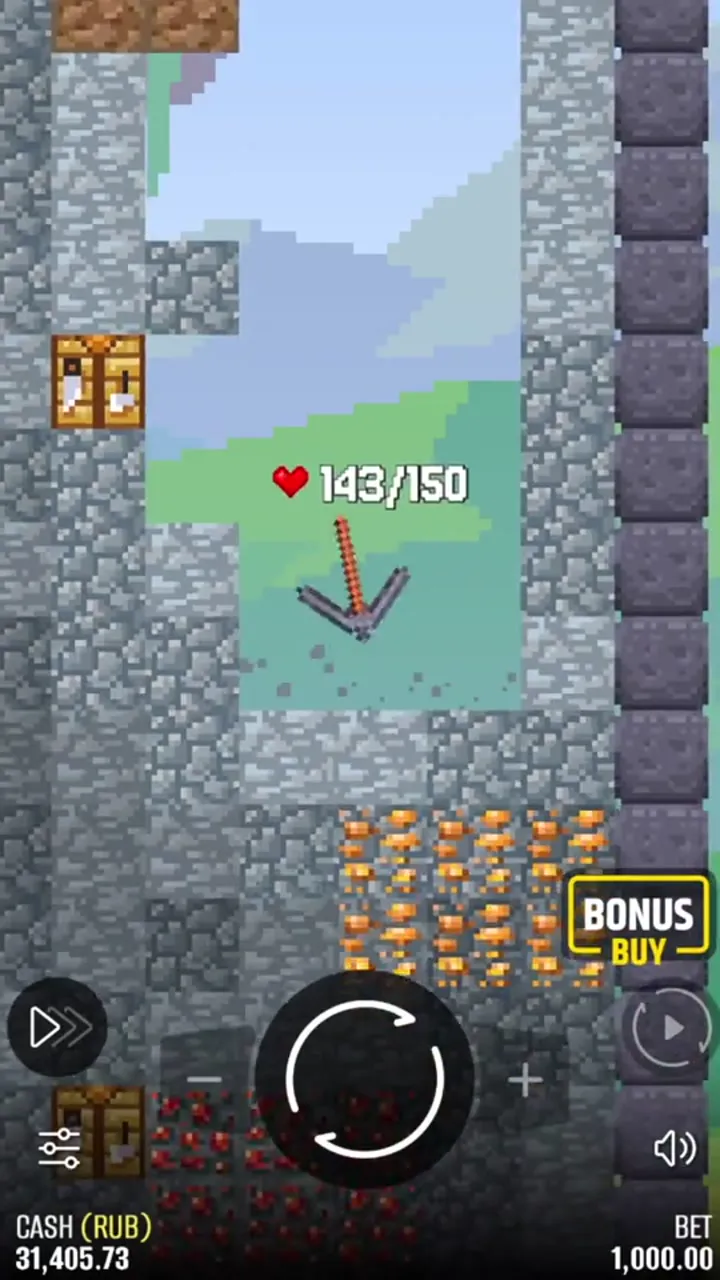
- HP counter — for example 352/400. It drops with every hit, even on dirt.
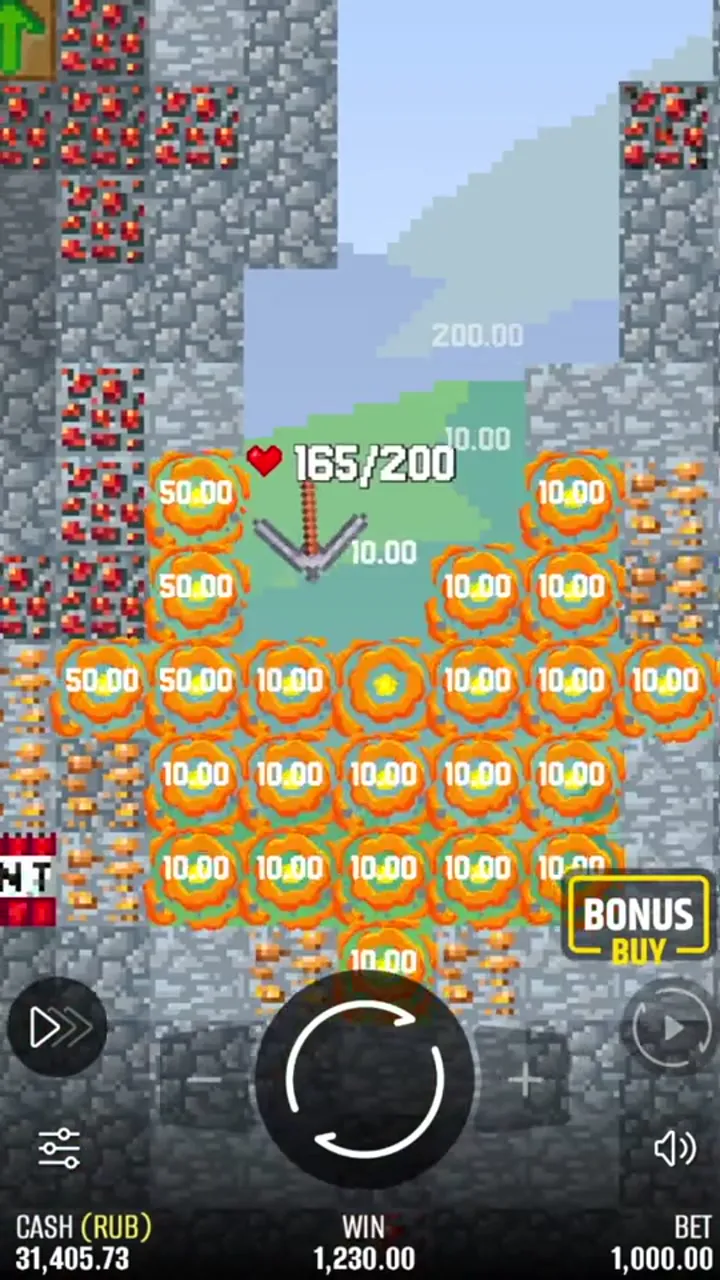
- Sums above blocks — the payout for that broken block in your bet currency.
Those sums are shares of the bet. On a 1,000 bet copper pays 10, redstone 50, gold 200, diamond 1,000 and emerald 5,000. On a ₱100 bet the same blocks pay ten times less. Why some blocks are worth more and how many hits they take is explained in the Falling Pickaxe mechanics guide.
When the round ends and the win is paid
A round ends in one case only — when the pickaxe’s HP reaches zero. The win builds up during the drop and is paid at the end as one sum. You can’t take it earlier: there is no cash-out button like in crash games.
A round can be extended in only one way, and it is not up to you: if the pickaxe breaks a Workbench, its durability is fully restored and it moves up a tier. That is how a wooden pickaxe can become a diamond one within a single round.
Turbo and autoplay
Turbo speeds up the animation. Speed has no effect on the result: the mine and the payouts are the same, you just see them faster. Tip: play your first 10–20 rounds at normal speed. You will learn what copper, gold, emerald, TNT and the Workbench look like and understand where each sum came from.
Autoplay runs several rounds without tapping. Handy, but risky: money goes faster than you can count it. Only switch it on with a set number of rounds.
Falling Pickaxe strategy: what works and what doesn’t
No system beats Falling Pickaxe. The game decides the pickaxe’s path and the mine’s contents, not you. The 95% RTP is the same for any bet size and any betting order. What you do control is how much you lose and how long you play.
- Fixed bet. Pick 1–2% of your session budget and don’t change it after a run of crosses or a big win.
- Set limits first. Decide before the first spin how much you will spend and how long you will play.
- No chasing. Doubling after a loss (Martingale) quickly hits the casino’s bet limit in a game capped at x160.
- Demo before money. A couple of dozen rounds in demo mode is the best way to learn the rhythm risk-free.
To see what a session costs on average at your bet, use the calculator on the Falling Pickaxe RTP page.
Common beginner mistakes
Mistaking depth for a big win
The pickaxe went deep, so the win must be big? No. If it flew through dirt and stone, the payout is close to zero. Only ore blocks pay.
Confusing the sum with the multiplier
“1,000” above a block on a 1,000 bet is x1, not x1000. To get the round multiplier, divide the win by the bet.
Expecting a diamond pickaxe to pay off
400 HP is a long path, not a guarantee of ore. A diamond pickaxe over empty rock can pay less than a wooden one that hits an emerald straight away.
Starting on turbo
At high speed the drop becomes a flash and you can’t tell where the sum came from. Start at normal speed.
Falling Pickaxe rules: questions
How do I start a round of Falling Pickaxe?
Set your bet with “−” and “+” and press the round spin button. The reel then decides whether you get a pickaxe.
What does a cross on the reel mean?
A round without a pickaxe: no drop, the bet is lost. After seven crosses in a row, the eighth spin always gives a pickaxe.
When is the win paid?
When the pickaxe’s durability reaches zero. Everything it collected during the drop is paid as one sum.
Can I cash out early?
No. Falling Pickaxe has no early cash-out button; the round always runs until the pickaxe breaks.
Is there a winning strategy?
No strategy changes the result: the pickaxe’s path and the mine’s contents don’t depend on you. Only bankroll management works — a fixed bet and a session limit.
What does the Bonus Buy button do?
It buys a bonus round for a separate price. The cost and conditions are shown in the game when you press it.