
Game maths · Pixmove data
Falling Pickaxe RTP: 95%, Low Volatility and an x160 Max Win
Falling Pickaxe has three key numbers: 95% RTP, low volatility and an x160 max win per round. Here is what each one means for your balance, plus a calculator for the average cost of a session.
Contents
- Falling Pickaxe RTP, volatility and max win
- What 95% RTP means in Falling Pickaxe
- Calculator: what a Falling Pickaxe session costs
- Low volatility: how it feels
- The x160 max win
- RTP doesn’t depend on bet size, turbo or strategy
- Can you test the RTP in the Falling Pickaxe demo?
- How the Falling Pickaxe RTP compares with other games
- Falling Pickaxe RTP: questions
Falling Pickaxe RTP, volatility and max win
| Metric | Value | What it means |
|---|---|---|
| RTP | 95% | For every ₱100 wagered the game returns ₱95 on average over a very long run |
| House edge | 5% | The average “price” of play — ₱5 per ₱100 wagered |
| Volatility | Low | Frequent small wins, fewer long dry spells |
| Max win | x160 | The limit for one round relative to the bet |
All three figures are published by Pixmove on the game card. The other specs are in the Falling Pickaxe game review.
What 95% RTP means in Falling Pickaxe
RTP (return to player) is the share of bets the game pays back as wins. It is measured over millions of rounds from all players, not over your session. 95% does not mean you will get ₱950 back from ₱1,000. It means that over a huge distance the casino keeps 5% of the total wagered on average.
Remember that total wagered is not your deposit. With ₱1,000 and a ₱50 bet, 50 rounds add up to ₱2,500 wagered and an expected cost of ₱125 — even though you never topped up.
Why your session won’t be 95%
In an evening you play hundreds of rounds, not millions. Over that stretch the result can land far above or below 95%. That is normal and doesn’t mean the game is “rigged” or “hot”.
Calculator: what a Falling Pickaxe session costs
Enter your bet and the number of rounds. The calculator shows total wagered, the average return at 95% RTP, the average cost of the session and the single-round max win.
- Total wagered
- —
- Average return at 95% RTP
- —
- Average cost of the session
- —
- Single-round cap (x160)
- —
Averages use the 95% RTP. A real session of a few hundred rounds can finish well above or well below these numbers.
Example: 200 rounds at ₱50 is ₱10,000 wagered. On average the game returns ₱9,500, so the session costs ₱500. Your real result will differ, but the figure helps you choose a budget up front.
Low volatility: how it feels
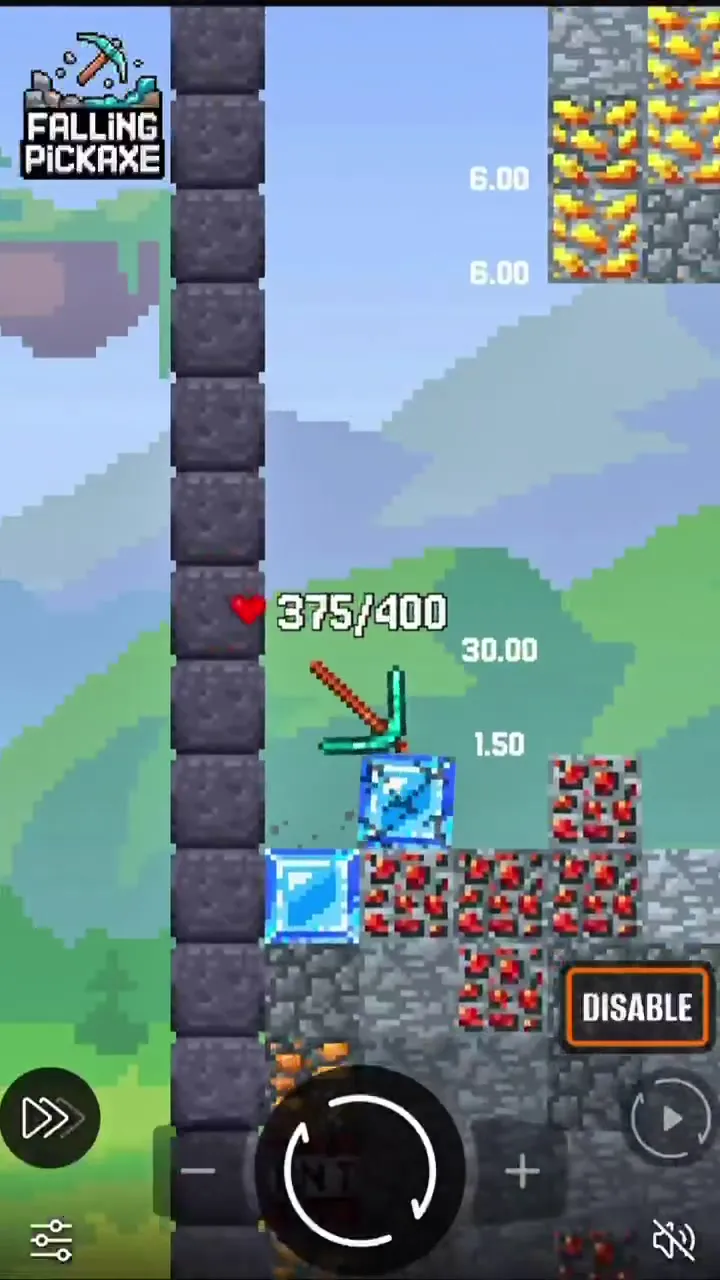
Volatility describes how unevenly wins are spread. In Falling Pickaxe it is low, and you can see it in the mechanics: most rounds pay a little — copper, redstone, sometimes gold. Long runs with no win at all are rarer than in high-volatility slots, but wins of thousands of times the bet are impossible.
Low volatility does not make the game more profitable. The house edge is still 5%; your balance just moves more smoothly. Runs of crosses and rounds of plain rock still happen.
The x160 max win
x160 is the cap for one round relative to your bet. On ₱10 it is ₱1,600, on ₱50 it is ₱8,000, on ₱500 it is ₱80,000.
The cap is rarely reached. The most valuable ore, the emerald, pays x5 and takes 30 hits. Reaching x160 with emeralds alone needs 960 hits, and the toughest pickaxe has 400. So without a Workbench to restore durability and TNT to blow up blocks, x160 is out of reach. The full calculation is in the Falling Pickaxe mechanics guide.
How not to confuse a sum with a multiplier
The numbers above blocks are amounts, not multipliers. “5,000” above an emerald on a 1,000 bet is x5. To get the round multiplier, divide the WIN field by your bet. For example, 1,230 on a 1,000 bet is x1.23.
RTP doesn’t depend on bet size, turbo or strategy
- Bet size changes the amounts, not the percentage. Gold pays x0.2 at ₱10 and at ₱1,000.
- Turbo speeds up the animation, not the maths.
- The Upgrade Arrow widens the pickaxe within a round, and it is already part of the 95%.
- Raising the bet after a loss doesn’t “catch up” with the RTP: every round is independent, while total wagered and average losses grow.
Can you test the RTP in the Falling Pickaxe demo?
No. For the actual return to approach 95% you need hundreds of thousands of rounds. Ten lucky rounds in the demo are chance, and so are ten unlucky ones. The Falling Pickaxe demo is useful for something else: seeing the blocks, learning what they pay and getting used to the interface.
How the Falling Pickaxe RTP compares with other games
95% is a typical figure for instant games and lower than many video slots, where RTP is often 96% or more. A difference of 1–2 percentage points only shows over long play: on ₱10,000 wagered it is about ₱100–200 on average.
Don’t pick a game on RTP alone. With Falling Pickaxe, what matters more is whether the format suits you: no control, no early cash-out, frequent small wins. If it does, start with a sensible bet and a session limit. How to do that is covered on the responsible play page.
Falling Pickaxe RTP: questions
What is the Falling Pickaxe RTP?
95% according to the developer, Pixmove. The house edge is 5% of total bets over the long run.
What is the Falling Pickaxe volatility?
Low. Wins come more often but are small, and a round is capped at x160.
What is the max win?
x160 your bet per round: ₱8,000 on a ₱50 bet.
Does the RTP depend on bet size?
No. The 95% RTP is the same at any bet. The bet only changes the size of wins and losses in pesos.
Can I check the RTP in the demo?
No. Even a few hundred rounds is far too small a sample. The demo is for learning the rules, not measuring the percentage.
Do turbo or the Upgrade Arrow change the RTP?
No. Turbo speeds up the animation and the arrow widens the pickaxe, but the game’s maths model stays the same.